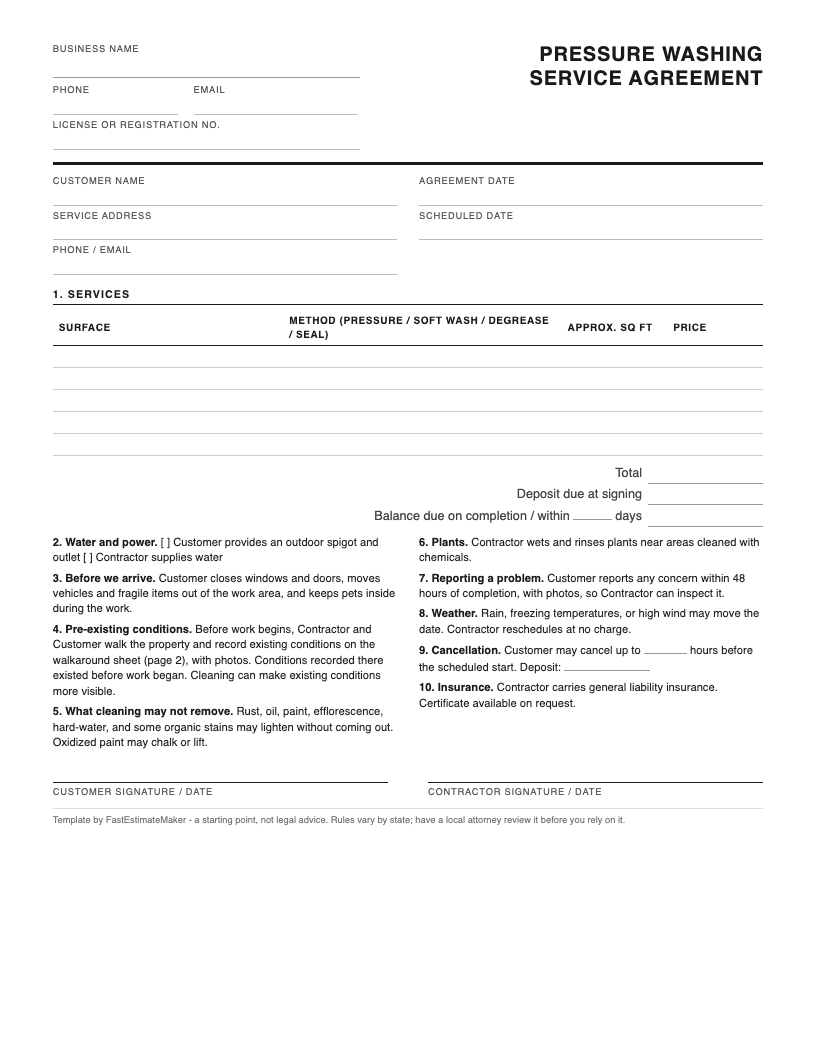
What this pressure washing contract covers
Most arguments on a pressure washing job start with something nobody wrote down: whose water, what "clean" means on an oil stain, and whether that crack in the siding was there yesterday. The agreement puts each of those on paper before the machine starts:
- Services by surface - driveway, siding, deck, roof, fence - with the method (pressure wash, soft wash, degrease, seal), the approximate square footage, and the price on every line.
- Water and power - customer spigot or contractor-supplied water, checked off, so nobody is surprised on the day.
- Before we arrive - windows closed, vehicles and furniture moved, pets inside.
- Pre-existing conditions - the clause that points to the walkaround sheet on page two.
- What cleaning may not remove - rust, oil, paint, efflorescence, and hard-water stains may lighten without coming out, and oxidized paint can chalk or lift.
- Reporting a problem - the customer tells you within 48 hours, with photos, so you can come look.
- Weather, payment, cancellation, and insurance - the rain date, when the balance is due, the cancellation window, and a line stating that you carry general liability insurance.
The pre-existing conditions clause
Pressure and chemicals do not create most of the damage a homeowner notices after a wash - they reveal it. Clean vinyl shows the crack that dirt was hiding. Chalky paint lifts where it was already failing. Etched glass looks worse once it is clean. The clause says that conditions recorded on the walkaround sheet were present before work began, and that cleaning can make them more visible. It does not ask the customer to give up anything. It records what was there.
The walkaround sheet on page two
Walk the property with the customer before you unroll a hose. Write down every existing problem you see - loose panels, oxidized paint, failed window seals, rotted deck boards, cracked concrete, plants that are already dying - and photograph each one. Both of you initial the sheet. When the job is done, the bottom of the page records the final walk: no concerns, or concerns noted.
The ten spots worth checking on every house: siding, windows and screens, paint and trim, concrete and pavers, deck and fence, roof, plants near the work area, outdoor fixtures, anything left in the work area, and the hose bib.
Is this a waiver?
No, and it should not try to be one. A waiver asks the customer to give up a claim; this template records the condition of the property and the terms of the job. That is easier for a customer to sign and more useful when there is a disagreement, because it answers the real question - what did the surface look like before you started.
Insurance still comes first
A contract and a walkaround do not replace general liability insurance. If a wand goes through a screen, insurance pays for it; the walkaround settles the argument about the crack that was already there. Our guide to starting a pressure washing business covers what general liability insurance for a pressure washing business costs and when commercial clients ask for the certificate.
When you want it signed on a phone
Paper works. It also gets wet, left on the dash, and lost. In FastEstimateMaker you can save this agreement as a contract template, attach it to the estimate, and the customer signs the estimate and the agreement together on their phone, with a signature certificate on the signed PDF.
On job day, the pre-job walkaround does the job of page two on your phone. The camera opens right in the browser, with no app to install. A checklist for the trade guides the before photos, you add a note to every photo, and each walkaround holds up to 30 before and 30 after photos. The homeowner signs off on your phone or from a link you text or email, and each photo carries the time it was taken, the upload time, and its distance from the service address.
Price the job first - the pressure washing pricing guide has 2026 rates by surface, and the pressure washing estimate template is the one-page quote that comes before this agreement.
This template is a starting point, not legal advice. Contract and consumer-protection rules vary by state; have a local attorney review it before you rely on it.